
 Visitors to the Baldwyn area and the battlefield are encouraged to travel and experience the “Brice’s Crossroads Battlefield-Chief Tishomingo Scenic Byway” that begins at the Mississippi Final Stands Interpretive Center (formerly the Brice’s Crossroads Visitors’ and Interpretive Center).
“The Brice’s Crossroads Battlefield-Chief Tishomingo Scenic Byway represents a tremendous educational, economic and tourism opportunity, and we are excited to designate this tourist designation,” Northern District Mississippi Highway Department Commissioner Mike Tagert said during the dedication of the byway,.
The Mississippi Department of Transportation (MDOT) placed seven signs, marking a segment of roadway in Lee and Prentiss counties as an official Mississippi Scenic Byway to be known as the “Brice’s Crossroads Battlefield-Chief Tishomingo Scenic Byway”.
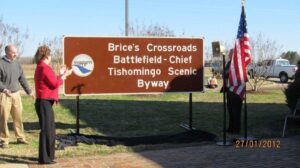 Named for the civil war battlefield and the tribal meeting sites and home site of Chickasaw Indians, the byway begins at the center where motorists can find archeological artifacts on display and interpretation of the battlefield and Chief Tishomingo.
“The main goal of byway designation is to tell the history, identify resources, and work together to enhance the visitor’s experience,” said Lindsey Neatherland, planning division, MDOT.
Edwina Carpenter, former Director of the MS Final Stands Interpretive Center, along with local historian Mitch Caver, submitted the application and the Corridor Management Plan that was approved by the Mississippi Department of Transportation and the Mississippi Scenic Byways Committee in 2011. The Natchez Trace Parkway is also designated National Scenic Byway.
Rep. Jerry R. Turner, who introduced legislation during the 2011 Mississippi Legislative Session designating a segment of MS Highway 370 in Lee and Prentiss counties as the “Brice’s Crossroads Battlefield-Chief Tishomingo Scenic Byway” spoke about the importance of historic and scenic sites in promoting tourism in our state.
Continuing from the Interpretive Center, the byway route travels north on Grisham Street to its intersection with MS Highway 370, then continues west on Highway 370 to its intersection with County Road 833, then continues southeast on CR 833 to its intersection with CR 503, then proceeds south on CR 503 to its intersection with MS Highway 348, and then continues east on MS Highway 348 to its intersection with MS Highway 145 at Guntown.
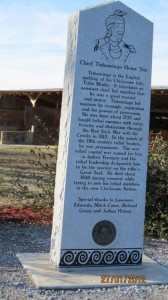 The byway takes visitors to the home site of Chickasaw Chief Tishomingo and several tribal sites, including Newberry’s and Campbelltown along CR 503 and Highway 348. Also along the route are several historic cemeteries that date to the settlement of the area. Tourists visiting the center and the battlefield can use the road and enjoy pull-offs and trails where interpretive signs educate the public. The byway will heighten the public’s awareness of the battlefield and the interpretive center where thousands visit annually, as well as the presence of the Native-American culture and heritage of the area.
A brochure and maps are available at the center.
A memorial dedication to the memory of Chickasaw Indian Chief Tishomingo as Soldiers of the War of 1812 was hosted by the Major General Thomas Pickney Chapter Daughters of 1812 on October 18, 2014.
The Welcome was given by Thelma Saxon, president of the chapter, where a marker stands identifying the homesite of Chief Tishomingo on CR 503 in Guntown.
The invocation was given by Judge James Roberts, followed by the pledge led by Lottye Bettes Beasley.
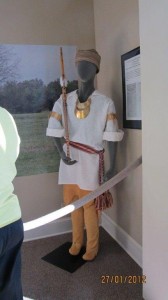 Local historian Mitch Caver presented the history of Chief Tishomingo and Chief George Colbert, soldiers in the War of 1812.
The site is located on the Brice’s Crossroads-Chief Tishomingo Scenic Byway designated by the Mississippi Department of Transportation in 2011. Mallie Fitzgerald, former member of the Byway committee, shared the purpose of meaning of the byway.
The dedication included a responsive reading and placing of a plaque honoring the service of the Chief.
The group dismissed and drove to the site of Chief George Colbert’s home near Tupelo, where a plaque was placed.
Mallie Fitzgerald, former committee member for the Brice’s Crossroads-Chief Tishomingo Scenic Byway, spoke about the importance of the byway at the Chief Tishomingo home site during the dedication ceremony honoring the chief for his service in the War of 1812. The service was hosted by the Thomas Pickney Chapter of the Daughters of the War of 1812 on October 18, 2014.